


Views: 0 Author: Site Editor Publish Time: 2026-10-19 Origin: Site


Have you ever stood on a bustling textile production floor and watched intricately patterned fabrics spool out at thousands of picks per minute? If you have, you know that modern manufacturing demands a brutal balance. You need the exact precision of heritage craftsmanship, but you also need relentless, high-speed output. Traditional weaving, while structurally robust, is inherently slow. It creates a massive bottleneck for commercial scalability.
Today, facilities relying on outdated mechanical systems experience severe production delays and lose out on lucrative custom contracts. How does modern engineering solve this critical problem? By bridging historical binary logic with cutting-edge servo-driven technology. In this technical guide, we will break down the mechanics, commercial value, and exact specifications needed to optimize your narrow fabric production line.
Limitless Patterning: The core engineering of this shedding technique allows for individual warp thread control. This enables highly complex, non-repeating patterns without constant manual retooling.
Industrial Output: Specialized narrow fabric equipment has completely transformed the craft. You can now mass-produce complex elastics, safety webbing, and branded ribbons at unprecedented RPMs.
Measurable ROI: Upgrading to computerized electronic heads drastically reduces mechanical downtime. It minimizes material waste and expands high-margin B2B customization offerings.
Future-Proofing: Current trends heavily favor smart textiles and micro-customization, making electronic hook control a baseline requirement for modern factories.
To truly understand the value of your factory's machinery, we must briefly look at its mechanical foundation. The original process, invented in 1804, replaced the agonizingly slow "drawloom." Instead of a human assistant physically lifting warp threads, a mechanical module controlled by stiff punch cards took over.
A hole in the card allowed a mechanical hook to pass through, lifting a specific warp thread. Solid cardboard kept the thread down. This binary system of "lift" or "do not lift" revolutionized manufacturing. It guaranteed perfect pattern consistency. More importantly, this binary logic directly inspired the first mechanical computers.
However, changing patterns on these early machines meant physically punching and lacing together thousands of new cards. Modern production floors simply cannot accommodate days of mechanical retooling. Today, we have replaced physical cards with intuitive Computer-Aided Design (CAD) software and advanced electromagnets. Designers render patterns on a screen, and the digital file transmits directly to the machine's microprocessor. Instant pattern changeovers with zero mechanical retooling are now the industry standard.
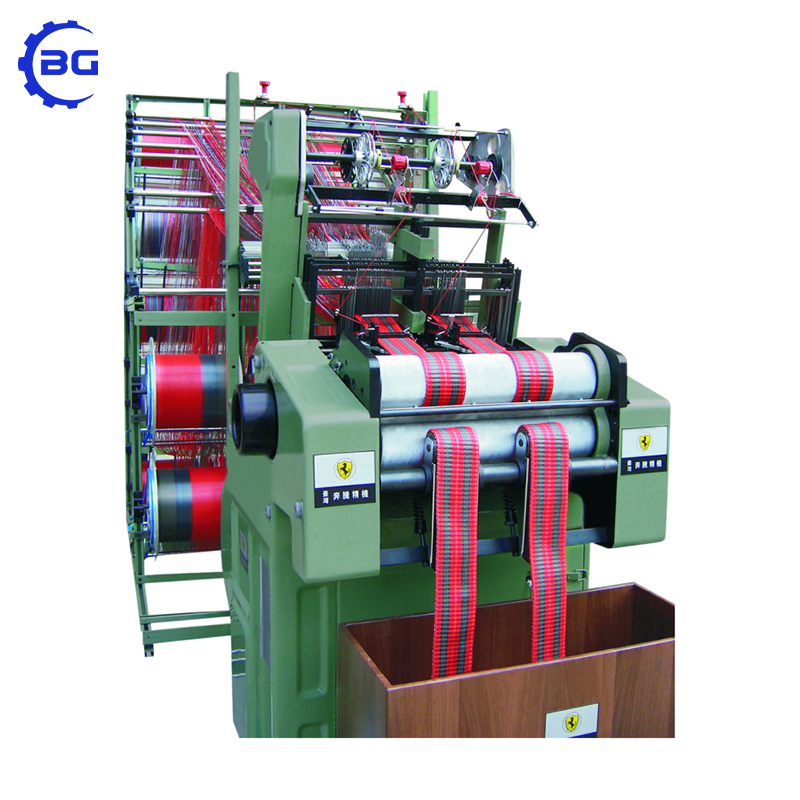
While traditional broadloom systems weave wide fabrics like upholstery, the commercial market desperately required a solution for narrow fabrics. This specific necessity led to the engineering of the Jacquard needle loom.
How does it actually work on the floor? Rather than using a traditional flying shuttle, a needle loom deploys a rapid weft insertion needle. This needle carries the yarn across the shed and secures it instantly with a latch needle, forming a durable knitted selvedge. By mounting an electronic shedding head onto a high-speed chassis, engineers successfully merged bespoke patterning with everyday functional production.
Specifically, the transition from mechanical levers to electronic microprocessors is a game-changer. Piezoelectric modules or electromagnets receive instantaneous signals to engage or disengage the hooks holding the warp threads. The only limit to a pattern's complexity is the number of hooks on the machine.
To quantify the upgrade, let's look at the hard data comparing legacy mechanical frames to modern electronic systems.
Specification | Legacy Mechanical Jacquard | Modern Electronic Jacquard |
|---|---|---|
Pattern Setup Time | 24 to 48 hours (manual card punching) | Under 5 minutes (USB/Network transfer) |
Operating Speed | Low to Moderate (limited by mechanical friction) | Extremely High (Servo-driven stability) |
Hook Capacity | Limited (heavy physical lifting required) | Scalable (192, 384, 512, up to 768+ hooks) |
Maintenance | High (frequent part wear, lubrication needs) | Low (automatic lubrication, fewer moving parts) |
Defect Rate | High (susceptible to card wear and slippage) | Minimal (precise electronic tension control) |
Before specifying new equipment, procurement managers must analyze where the market is heading. Recent industry data shows a massive shift in B2B procurement. Buyers are no longer satisfied with generic, commoditized plain webbing. There is a distinct demand for structurally integrated patterns that echo bespoke craftsmanship, yet can be delivered at mass-market volumes.
Furthermore, the supply chain is localizing. Brands want smaller, highly customized batches delivered faster. This "micro-customization" trend makes long setup times unacceptable. Additionally, the rise of "smart fabrics" is reshaping the sector. Because the electronic shedding mechanism allows for the exact geometric placement of individual threads, manufacturers are now weaving conductive metallic or carbon-infused yarns directly into narrow fabrics. We are seeing this applied in biometric monitoring straps for healthcare and data-transmitting ribbons for tactical gear. If your machinery cannot handle precise tension variations of conductive yarns, you will be locked out of this high-margin market.
The true commercial viability of a high-speed automatic Jacquard machinery lies in its specialized focus. You aren't producing bedsheets; you are manufacturing critical structural components.
In the highly competitive garment industry, brand visibility is paramount. These advanced looms are heavily utilized to produce branded underwear elastics, where a company’s logo is seamlessly woven directly into the stretchable waistband. Why does this matter? Printing a logo onto plain webbing is cheaper upfront, but surface ink peels, cracks, and fades due to friction. Weaving the logo directly into the fabric matrix ensures the design lasts exactly as long as the webbing itself.
Beyond aesthetics, this weaving technique plays a life-saving role in industrial safety. Heavy-duty webbing used in cargo tie-downs, lifting slings, and fall-protection harnesses are continuously woven on these machines. The structural integrity provided by the weave ensures these narrow fabrics meet strict tensile strength requirements without compromising clear manufacturer identification.
Investing in industrial textile machinery requires a meticulous evaluation of technical specifications. If you are upgrading your facility, evaluating a narrow fabric webbing loom involves analyzing several critical engineering features.
1. Hook Count and Head Configuration:
The electronic head's capacity is defined by its hook count. Each hook controls a warp thread. If your target market demands highly intricate, edge-to-edge designs on wider webbing, you need higher hook counts. For example, standard high-performance models like the PTA-2/65 are engineered for dual-head output (weaving two tapes simultaneously) with a maximum weaving width of 65mm. To support complex logos across a 65mm width, selecting a configuration with 384 or 512 hooks is highly recommended to maintain crisp design resolution.
2. Machine Speed and Frame Stability:
High-speed weaving generates immense kinetic energy. Buyers must prioritize looms constructed with heavy-duty, cast-iron or reinforced steel frames. A lightweight chassis will vibrate under load. This vibration leads to premature component wear, erratic fabric tension, and frequent thread breakages. Precision-engineered internal drive shafts ensure the machine sustains maximum RPM across multiple shifts without thermal expansion issues.
3. Software Compatibility and Lubrication:
The mechanical hardware is only as effective as the digital software controlling it. Verify that the machine's HMI (Human-Machine Interface) is fully compatible with standard textile CAD formats (like JC5 or EP files). Additionally, industrial environments are harsh. Automatic lubrication systems are mandatory. They deliver precise oil volumes to critical moving parts, drastically reducing your maintenance team's manual workload.
Jacquard weaving has evolved from a mechanical marvel into a cornerstone of high-tech textile manufacturing. The core artistry of the weave remains, yet the technology utilized to produce it has reached unparalleled heights of efficiency. Upgrading to advanced, automated machinery eradicates production bottlenecks, slashes daily material waste, and unlocks a highly profitable realm of product customization.
For narrow fabric manufacturers looking to dominate their market segment, relying on outdated looms is a liability. Investing in robust, computerized equipment is a strategic necessity to secure future growth. If you are ready to scale your production, reduce downtime, and capture high-margin custom orders, explore the advanced PTA-2/65 Jacquard loom and other industrial solutions from B&G Machinery to find the exact specifications that fit your factory's needs.
A standard needle loom utilizes a harness system that controls groups of warp threads simultaneously. This restricts its output to plain fabrics or simple, repeating geometric patterns. In contrast, a Jacquard needle loom features a specialized electronic shedding mechanism capable of controlling each warp thread individually. This independent control allows for the creation of highly complex, non-repeating custom patterns directly within the narrow fabric.
Modern computerized looms are engineered for extreme versatility. They can process a wide array of natural and synthetic fibers, including cotton, polyester, nylon, and polypropylene. Additionally, advanced tension control systems allow them to handle specialized yarns. This includes elastane for stretch fabrics, aramid fibers (like Kevlar) for safety applications, and even conductive threads used in smart textiles.
Not at all. Modern electronic systems have streamlined the process. Designers utilize intuitive CAD software tailored for textile manufacturing. A logo is digitized into a grid format and exported as a machine-readable file. This file is transferred to the loom's control panel via USB or local network. The entire pattern changeover process takes minutes, requiring minimal physical intervention from the operator.
From a durability standpoint, woven logos are vastly superior. Surface printing applies ink to the top layer of the fabric, which fades and peels when exposed to friction or washing. Because a Jacquard machine weaves the logo directly into the structural matrix of the fabric using colored yarns, the design is permanent. It ensures the branding remains legible throughout the entire lifespan of the heavy-duty product.
The required hook count correlates directly to the maximum complexity and width of your patterns. If your production focuses on narrow items with simple text, 192 or 256 hooks are typically sufficient. However, if you produce wider webbing (such as 50mm to 65mm) with detailed corporate logos, a machine equipped with 384, 512, or 768 hooks is necessary to provide the required resolution.
While specifications vary by model, standard heavy-duty narrow fabric looms typically accommodate widths ranging from 20mm up to 85mm. For example, highly versatile models are often optimized for a 65mm maximum width. This specific width strikes an ideal balance, allowing manufacturers to produce everything from standard 25mm bag straps up to wider 65mm safety harnesses on the same machine frame.
Legacy mechanical systems rely on physical punch cards and levers, which wear down and slip over time, causing skipped stitches. Electronic hook control utilizes electromagnets to engage warp threads instantaneously. This flawless synchronization between the weft insertion needle and the electronic head maintains uniform yarn tension across the entire warp beam. It eliminates puckering and uneven edges, drastically reducing your rate of defective goods.


