


Views: 0 Author: Site Editor Publish Time: 2026-10-15 Origin: Site


Integrating advanced wire and textile processing equipment forms the absolute backbone of modern manufacturing operations. Whether a facility is extruding heavy-duty industrial cables, fabricating aerospace composites, or weaving delicate medical textiles, the daily yield relies heavily on the specific mechanical capabilities of the chosen equipment. For B2B buyers, plant managers, and lead engineers, the procurement of industrial machinery represents a critical capital expenditure. It is a decision that directly dictates future production bottlenecks, operational efficiency, and ultimately, market competitiveness.
Investing in the wrong machinery frequently leads to a cascade of factory floor disasters: high rates of material waste, erratic tension causing snapped threads, increased manual downtime, and a severely crippled return on investment (ROI). In an era where supply chain agility dictates success, relying on outdated or improperly specified equipment is a massive operational liability. This comprehensive guide is designed to walk procurement teams and engineers through the exact technical criteria required to select a high-performance industrial braiding machine tailored specifically to your operational parameters. By understanding specific mechanics, carrier configurations, and material compatibility, you can effectively future-proof your production lines.
Mechanical Alignment: Matching the equipment's construction type to your raw materials (e.g., copper wire vs. carbon fiber) is the most critical step in preventing premature gear wear and material degradation.
Output Metrics: Production speed (RPM), carrier count (e.g., 48-carrier setups), and bobbin volume dictate your overall yield and cost-per-meter.
Efficiency Gains: High-speed, multi-head rotary configurations offer a significantly faster payback period by doubling output within the same floor footprint.
Total Cost of Ownership: Evaluating industrial machinery requires looking beyond the sticker price to assess long-term maintenance needs, automated fault-detection, and reliable after-sales support.
The global market for textile and wire weaving equipment is undergoing a massive paradigm shift. Driven by the demand for higher precision, Industry 4.0 automation, and extreme material versatility, the days of relying on purely mechanical, operator-heavy looms are fading. Today, the industrial landscape demands maximum output yields without compromising a fraction of a millimeter on structural integrity.
Recent industry analyses highlight a surging macro-trend toward "lightweighting," particularly within the electric vehicle (EV), renewable energy, and aerospace sectors. Manufacturers are aggressively seeking ways to reduce the weight of wire harnesses and structural components while simultaneously increasing tensile strength and shielding effectiveness. This requires processing advanced synthetic fibers like Kevlar, UHMWPE, and carbon fiber alongside traditional copper. Consequently, the demand for precision-engineered advanced braiding machines has skyrocketed. Legacy systems simply lack the electronic tension tolerances and optical sensors required to process these expensive, unforgiving modern composites.
Furthermore, relying on outdated equipment introduces hidden, compounding costs into manufacturing facilities. Older mechanical tensioning systems often fail to adapt to minor variations in raw material thickness, leading to uneven weave patterns and entire rejected batches. By upgrading to contemporary systems equipped with variable frequency drives (VFD) and automated fault-detection, facilities can drastically reduce the labor hours required for continuous operation, translating capital investments directly into improved profit margins.
To make an informed procurement decision, buyers must look under the hood. The fundamental mechanical architecture dictates the apparatus's maximum speed, vibration levels, and compatibility with rigid versus flexible materials. From my experience on the factory floor, mismatching the machine type to the material is the number one cause of stranded capital.
The Maypole architecture represents the historical standard. These machines operate on a mechanism where carriers follow two intersecting sinusoidal paths, weaving over and under one another driven by slotted gears. Because of their relatively simple mechanics, Maypole configurations are highly effective for standard consumer products like basic ropes, fiberglass sleeving, and utility cords.
However, the primary drawback is operational speed. The complex, serpentine physical paths limit how fast the carriers can move without causing excessive friction or derailing. For high-volume B2B contracts, this speed limitation often creates a severe production bottleneck.
When evaluating heavy-duty equipment, the distinction between horn gear and track systems is paramount. Horn gear systems utilize heavy-duty gears with slots that physically transfer the carrier from one gear to the next. This design is exceptionally robust. It is the absolute preferred choice when processing stiff, unyielding materials like steel wire or heavy synthetic monofilaments, as the rigid transfer mechanism ensures that high tension does not derail the carrier.
In contrast, track systems propel carriers along a continuous machined groove using drivers beneath the surface. This dramatically reduces the mechanical impact of transferring carriers, resulting in noticeably less vibration. Track systems are highly suitable for delicate materials like medical sutures or fine technical yarns where minimizing friction is the priority.
The most significant leap in recent decades is the shift toward high-speed rotary architectures. Unlike traditional models, rotary machines utilize two counter-rotating mechanisms—one set of bobbins moves clockwise, the other counter-clockwise, with threads mechanically deflected over and under.
This streamlined design eliminates the serpentine path, allowing the machinery to operate at dramatically higher revolutions per minute (RPM). For facilities producing high-density technical textiles or automotive hoses, high-speed rotary models are non-negotiable. They provide the necessary volume to meet aggressive supply chain demands while maintaining exacting pitch standards.
Machine Architecture | Typical Speed (RPM) | Best Suited Materials | Ideal Application |
|---|---|---|---|
Traditional Maypole | 150 - 250 | Cotton, basic synthetics | Shoelaces, standard utility cords |
Horn Gear (Heavy Duty) | 200 - 300 | Steel wire, copper, monofilaments | Wire harnesses, coaxial shielding |
High-Speed Rotary | 350 - 500+ | Carbon fiber, Kevlar, precision yarns | Technical textiles, aerospace composites |
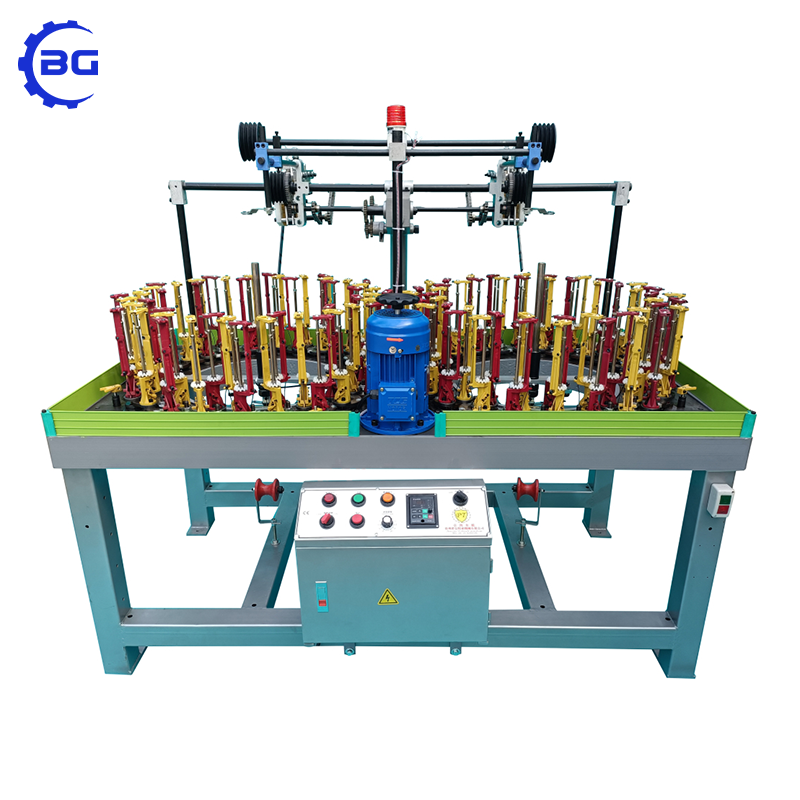
Selecting the correct equipment goes far beyond matching a budget to a brochure. B2B purchasing criteria must focus on the specific technical parameters that align with your factory floor realities. Specifically, engineers must evaluate carrier configurations, material capacity, and electronic controls.
The carrier count is arguably the most defining specification of your setup. It directly determines the diameter, structural coverage, and aesthetic pattern of the final product. While a 16-carrier setup is perfectly suitable for basic wire jackets, high-demand applications require much more.
For instance, high-pressure hose reinforcements or technical climbing ropes typically demand a 48-carrier configuration to ensure an exceptionally dense, tight weave. Furthermore, savvy plant managers look for multi-head units. Utilizing a dual-head machine allows for the simultaneous production of multiple cords, effectively doubling factory output without expanding the physical footprint of the production line.
Bobbin capacity directly impacts your Overall Equipment Effectiveness (OEE). The volume of material a bobbin holds dictates how long a line can run continuously before triggering a manual reload. In high-speed operations where material depletes rapidly, selecting equipment that accommodates larger spools slashes downtime.
Beyond size, the carrier design must match the raw material. Processing copper wire requires specialized carriers with heavy-duty tension springs to prevent wire looping. Conversely, weaving fiberglass requires ultra-smooth, friction-resistant eyelets to prevent brittle fibers from micro-fraying during transit.
The quality of any woven product is defined by its uniformity. Pitch—the longitudinal distance for one complete revolution of yarn—must remain perfectly consistent. Modern high-speed braiding equipment utilizes advanced servo motors to regulate haul-off speeds, ensuring a uniform pitch angle regardless of minor voltage fluctuations.
Precise tension control is equally non-negotiable. If tension is too loose, the structure is compromised; too tight, and delicate threads snap, creating costly defects. Industrial buyers should prioritize machines equipped with individually adjustable spring tensions on each carrier.
Industrial machinery is never one-size-fits-all. The optimal specification depends entirely on the regulatory standards and physical demands of your end-use application.
The technical textile sector demands uncompromising precision. Applications such as carbon-fiber composites and medical prosthetics require extreme structural density. Machines tailored for this industry must feature high carrier counts (like a 48-carrier setup) and robust tension controls capable of handling advanced synthetics without causing microscopic abrasions to the material.
Manufacturing electrical cables and coaxial shielding involves handling rigid metals. Equipment in this category must feature heavy-duty cast iron frames to withstand intense, continuous mechanical stress. Specialized wire carriers are strictly required to maintain consistent tension on copper or steel wires, ensuring optimal electrical conductivity without snapping the metal.
Capital expenditure must always be justified through a rigorous Return on Investment (ROI) analysis. Purchasing based solely on the lowest sticker price is a classic engineering pitfall that haunts manufacturers for years.
While traditional Maypole machines present an attractive initial purchase price, premium high-speed models deliver an exponentially higher long-term output. By operating at significantly higher RPMs and utilizing dual-head configurations, a single high-speed unit can often replace three legacy machines. This consolidation reduces overall energy consumption, minimizes required factory floor space, and drastically lowers the cumulative maintenance burden.
The payback period for a high-speed machine is accelerated by massive increases in production volume and heavily reduced labor costs. Because modern models incorporate automated yarn-breakage sensors and auto-stop mechanisms, a single operator can safely manage a larger fleet of machines simultaneously. When factoring in waste reduction, the slightly higher upfront cost is typically recouped within the first 12 to 18 months of continuous operation.
Procurement errors can lead to stranded capital, but poor maintenance will destroy even the best investment. Avoid these common pitfalls to protect your production line:
Ignoring Material Compatibility: A frequent error is purchasing a machine optimized for soft yarns and attempting to use it for stiff wires. This mismatch leads to rapid degradation of carrier eyelets and eventual mechanical failure of the gears.
Underestimating Future Capacity: Buying a machine that exactly fits today's quota is short-sighted. If you secure a larger contract next quarter, a standard-speed machine becomes an immediate bottleneck. Always factor in a 20-30% capacity buffer.
Improper Cleaning Protocols: When processing abrasive materials like carbon fiber, microscopic dust accumulates rapidly in track grooves. Using compressed air often blows this conductive debris deeper into optical sensors and enclosed gearboxes. Always use a dedicated industrial vacuum instead.
Choosing the right equipment is the most direct way to improve factory output, slash material waste, and secure a competitive edge. The procurement process requires a careful balancing act between desired production speed, appropriate carrier count, and strict material compatibility.
A tailored, high-speed setup prevents future bottlenecks and allows your facility to easily process demanding materials. If your operation requires scaling up production of dense technical textiles or precision cords, evaluating a robust, dual-head high-speed braiding machine like the POC-2-48A is the most logical operational upgrade. By investing in 48-carrier, high-RPM technology, you effectively future-proof your production line, ensuring high-quality, continuous output for years to come. For specific configurations and to match equipment to your exact B2B production needs, visit BG Braiding to consult with technical engineering specialists.
The primary difference lies in the final product shape and the track layout. Flat machines use a semi-circular or open track path to create ribbons, tapes, or laces. Tubular machines use a continuous closed-loop circular path to create hollow cords, ropes, or protective cable sleeves that completely encapsulate a core material.
The required carrier count depends entirely on the desired diameter of the final product and the specific weave density (coverage) you need to achieve. Smaller diameters can be accomplished with 16 to 24 carriers. Heavy-duty cables, high-pressure hoses, or dense technical textiles generally require 48 carriers or more to ensure full surface coverage and structural integrity.
Production speed (typically measured in meters per hour) is calculated by multiplying the machine's RPM by the number of horn gears, divided by the number of stitches per meter (pitch), and then factoring in the machine's efficiency rating (OEE). High-speed rotary machines drastically increase the RPM variable, thereby multiplying the final output length compared to traditional models.
Tension variations are typically caused by worn carrier springs, inconsistent bobbin winding from the upstream process, or debris buildup in the carrier eyelets. In older machines, mechanical friction points create drag. Modern machines mitigate this by using individually adjustable, high-fatigue springs and smooth ceramic or polished steel eyelets to maintain uniform tension.
With rigorous preventative maintenance, regular lubrication of the horn gears, and timely replacement of wear parts (like springs and carriers), a high-quality B2B machine can operate efficiently for 15 to 20 years. Longevity is heavily dependent on the operating environment and strict adherence to the manufacturer's specified material limits.


